


- April 21, 2026
- admin
- 0 Comments
- Uncategorized
Uttar Pradesh Warehousing and Logistic Policy, 2022
Warehousing and Silo Investors,
The investor who are going to plan investment in Warehousing sector in UP then he should consider the provision of subsidy as provided by the UP Govt in their Warehousing and Logistic Policy, 2022. We have framed the key parameters of Subsidy and related aspects thereof in the interest of readers, which are as:
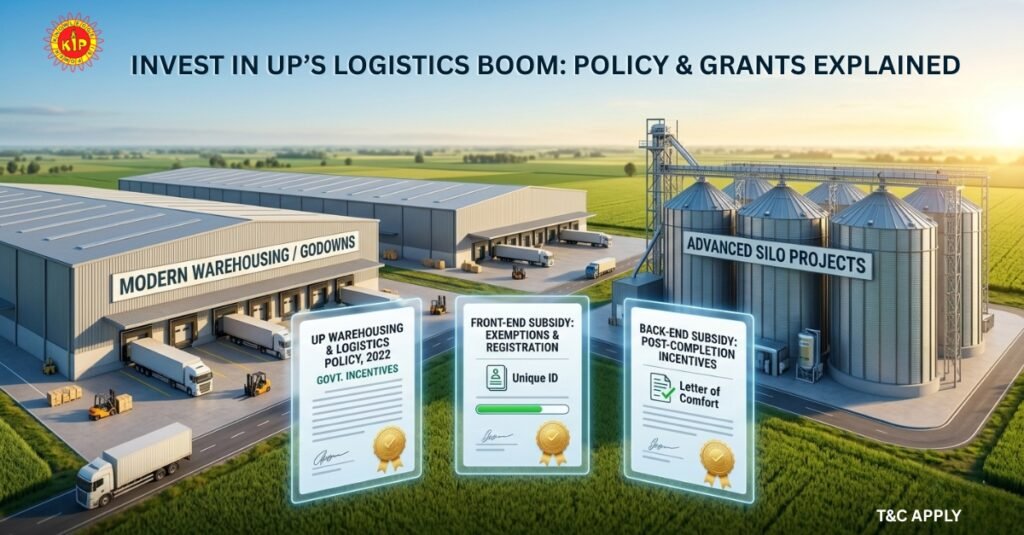
1. “Storage facilities” as defined in said Policy as–
- Warehouses including go-downs both open/ closed developed for handling and storage of cargo in bulk/ break bulk form.
- Silos built as vertical storage structures for storing bulk cargo in both solid and liquid form.
2. Subsidy for Silo Project:
Silo Project are covered under the storage facility hence eligible to take incentives as per said policy and there are two types of subsidies i.e Front End Subsidy and Back End Subsidy.
3. Subsidy Pattern:
- Front End Subsidy: The Front-end subsidies include exemptions/ concession which shall be allowed to the eligible projects as defined in this policy before commencement of commercial operations. Projects need to be registered with Nodal Agency and obtained Unique ID.
- Back End Subsidy: Back-end subsidy shall be provided after completion of project and commencement of commercial production. Projects need to be obtained Letter of comfort (LoC) for this.
Expert Insight: Navigating these registration steps is crucial. For detailed guidance on project structuring, visit KIP Financial Services.
4. Eligible Criteria for Capital subsidy:
- Warehouse including go-downs developed over minimum area of 1 lakh Sq. ft and minimum Capital Investment of INR 20 Crores.
- Silo developed over minimum area of 4-acres and minimum Capital Investment of INR 30 Crores.
5. Eligible Capital Investment:
Capital Investment Includes the following cost as:
- Land: The Actual Purchase price as per registered documents excluding stamp duty and registration fee subject to maximum of 40% of Total Capital Investment.
- Building: Only cost of construction of new building shall be taken not acquisition of old building and repair expenditure incurred thereon.
- Other Construction: Such as Compound wall, internal road etc.
- Equipment: Includes cost of Equipment, Inhouse Vehicle, Electrification etc.
Note: Working Capital shall not be part of Capital Investment.
Further Project should be operationalization within 3 Years from the Effective period of policy. In case, Capital Investment has been initiated prior to the Effective Date then at least 80% of Capital Investment should have been made after Effective Date during the eligible investment period and the same Capital Investment will be considered as the Eligible Capital Investment for determining admissible total incentives.
However, in case, investment in land is made prior to the Effective date, such investment in land shall not be eligible for any incentives but valuation of such land on book value shall be considered for determining the eligibility of the projects.
Resource: To understand the technical requirements for large-scale storage, check out our https://kip4business.com/product/warehouse-ebook/
6. Fiscal Incentives:
(i) Front end subsidies:
Stamp Duty exemption
- Exemption of Stamp duty on land purchased or taken on lease (for a period of at least 10 years) shall be provided at following rates:
- 100% in Bundelkhand and Poorvanchal region and region covered under ‘Taj Trapezium Zone’
- 75% exemption in Madhyanchal and Paschimanchal (except Gautambuddha Nagar & Ghaziabad)
- 50% exemption in Gautambuddha Nagar & Ghaziabad
Concession on Land use conversion charges
75% of Land Use conversion charges shall be waived off
- Exemption in Development Charges
75% of the development Charges shall be exempted
- Ground Coverage
Such standalone storage facilities will be allowed Ground Coverage up to 60%
(ii) Back-end subsidies:
Capital Subsidy
- Capital Subsidy to Warehouses/ Silos/ Cold Chain Facility shall be provided at the rate of 15% of Eligible Capital Investment subject to:
- maximum INR 5 crores for setting up such facilities anywhere in the State;
- maximum INR 10 Crores for setting up such facilities in the designated Logistics Zones.
Electricity Duty Exemption
- Exemption of Electricity Duty shall be provided at the rate of 100% for a period of 10 years
Quality Certification cost reimbursement
- Quality Certification cost reimbursement shall be provided at the rate of 50% of cost paid upto maximum INR 5 lakh per project
Skill Development Subsidy
- Skill Development subsidy shall be provided as reimbursement of stipend @INR 1000 per trainee per month for 6 months up to maximum 50 trainees per annum for 5 years per project
Note:
- Sum of all benefits including exemptions provided to any project shall not exceed 100% of eligible capital investment as defined under the policy.
- Towards this, the reimbursements shall be done to any project post commencement of commercial operations and evaluation of exemptions availed by the applicant against the unique ids issued by the Nodal Agency (if any).
- Projects benefited under this policy will be eligible to get admissible benefits of Govt. of India’s Plan Agriculture Infrastructure fund.
How KIP Powers Your Investment
Navigating government policies requires precision. KIP provides end-to-end consultancy to ensure your investment is seamless:
- Tender Support: Registration and participation in govt tenders.
- Project Reports: Bank-grade DPR (Detailed Project Report) preparation.
- Financial Engineering: Assistance in bank finance and structuring.
- Subsidy Management: Handling Central & State filing from start to finish.
Learn how to participate in tenders: Download Warehousing Tender eBook
Frequently Asked Questions (FAQs)
1. What is the difference between Front-end and Back-end subsidies under this policy?
Front-end subsidies (like Stamp Duty and Land Use conversion exemptions) are granted before commercial operations commence to reduce initial setup costs. Back-end subsidies (like Capital Subsidy and Electricity Duty exemptions) are provided after the project is completed and commercial production has started.
2. What are the minimum investment and area requirements for a Warehouse project?
To be eligible for the Capital Subsidy, a Warehouse must be developed over a minimum area of 1 lakh Sq. ft with a minimum Capital Investment of INR 20 Crores.
3. Does the cost of land count towards the “Eligible Capital Investment”?
Yes, the actual purchase price of land is included, but it is capped at a maximum of 40% of the Total Capital Investment. Note that if land was purchased before the policy’s effective date, its value counts toward eligibility, but it won’t receive direct incentives.
4. Are these state subsidies compatible with Central Government schemes?
Yes. Projects that benefit under the UP Warehousing and Logistic Policy, 2022, are also eligible to receive admissible benefits from the Government of India’s Agriculture Infrastructure Fund (AIF).
Reach Us
Call Us : 8683898080
E-mail Us : sales@kipfinancial.com
KIP Financial Consultancy Ltd.
DSB – 38, Red Square Market, Hisar – 125001 (HR
Leave a Comment